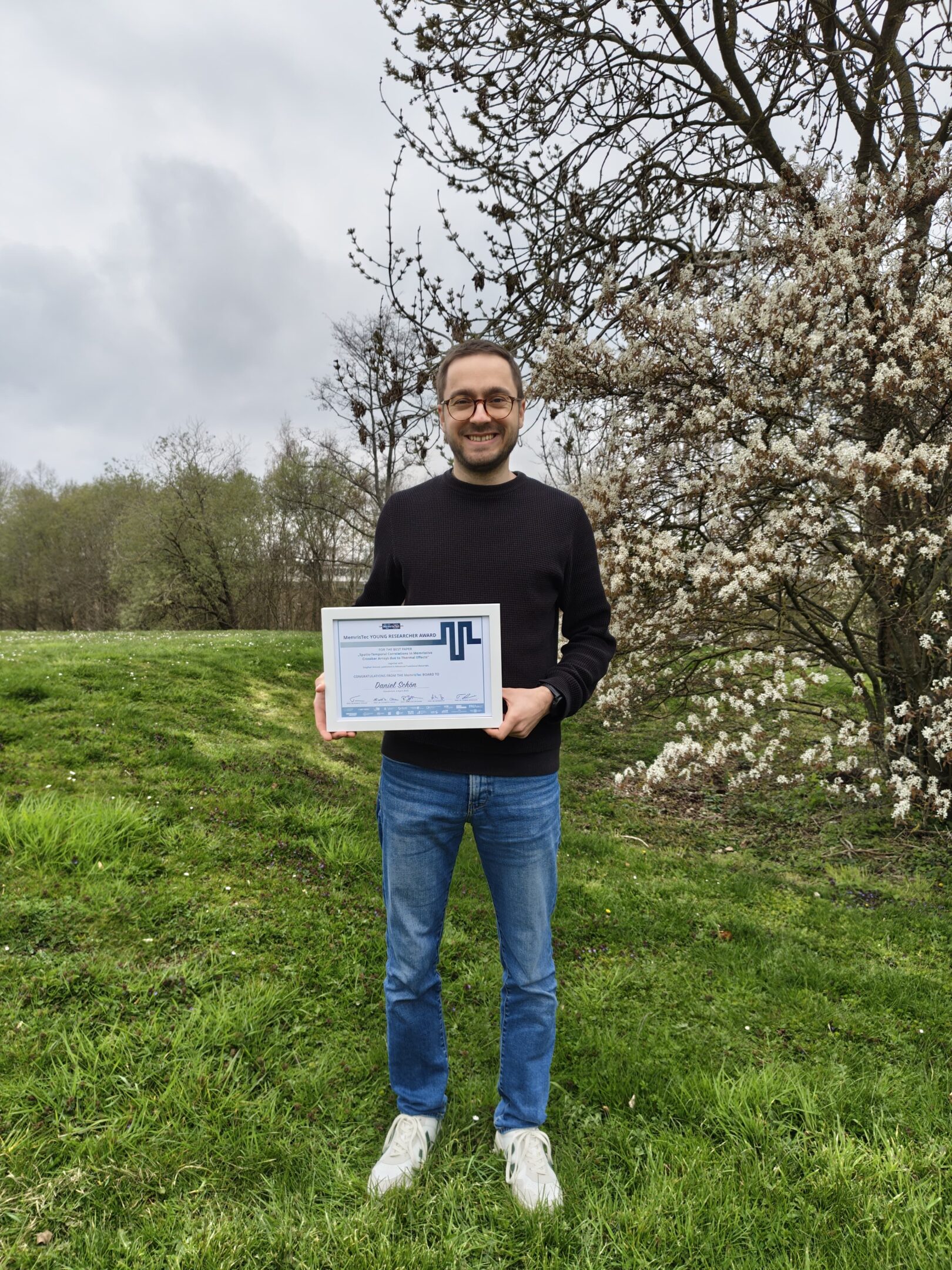
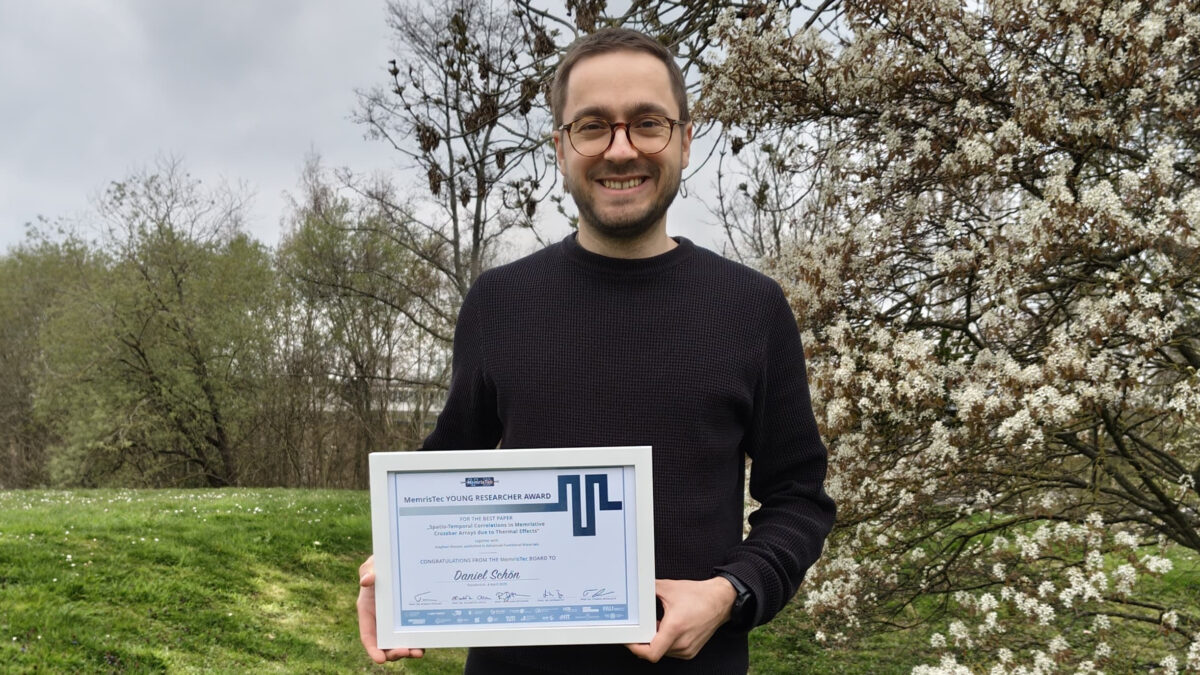
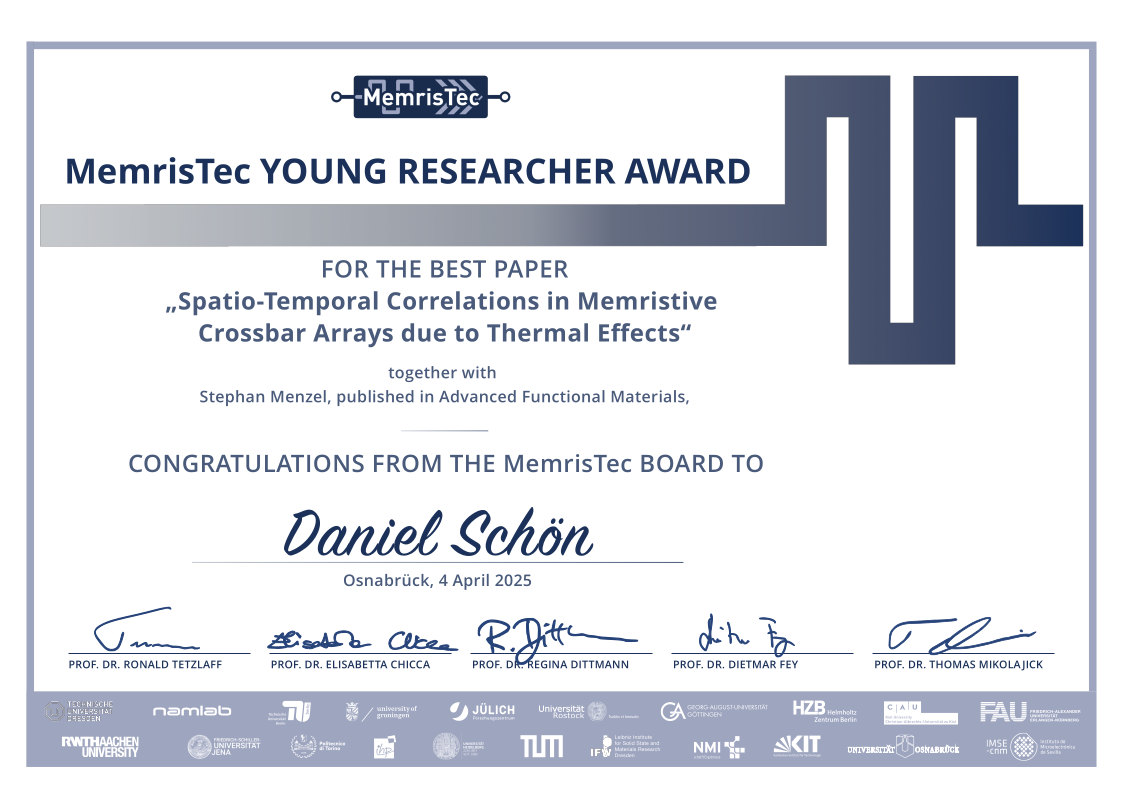
We are delighted to announce that Daniel Schön has been honored with a MemrisTec Young Researcher Award for Best Publication, presented by the DFG Priority Program MemrisTec (SPP 2262) — “Memristive Devices Toward Smart Technical Systems”. The award recognizes his outstanding contribution to the field of memristive devices and underscores his role as one of the program’s rising talents.
The recognized publication, titled “Spatio-Temporal Correlations in Memristive Crossbar Arrays due to Thermal Effects“, was published in Advanced Functional Materials by Daniel Schön and Stephan Menzel from the Peter Grünberg Institut (PGI-7), Forschungszentrum Jülich.
The work investigates how thermal effects influence the switching behavior of valence change memory (VCM) cells in highly integrated crossbar arrays. Using a finite element model coupled with a verified compact model of a VCM cell, the authors reveal that spatio-temporal thermal correlations can occur and significantly affect the resistive state of adjacent cells.
Key findings from the publication include:
- Thermal crosstalk: Heat generated in an active memristive cell propagates along the electrodes and can influence the resistance state of neighboring devices — an effect particularly relevant for device spacings of just a few hundred nanometers.
- Thermal accumulation effect: Due to the thermal capacitance of a VCM cell, the device can remain thermally active after a pulse, thereby influencing the temperature conditions of subsequent pulses. This allows temperature to act as a second state variable alongside conductance.
- Spatio-temporal correlations: When pulse spacings approach the thermal time constant of the device (a few nanoseconds), thermal crosstalk and accumulation combine — opening up new possibilities for neuromorphic computing, including emulation of short-term plasticity and paired-pulse facilitation.
As the authors conclude, “spatio-temporal thermal correlations can be observed for device spacings as small as a few hundred nanometers and pulse trains with pauses in the order of the thermal time constant of the memristive device. Based on this effect, novel learning rules can potentially be derived for future neuromorphic computing applications”.
The publication was a great ignition into the authors’ MemrisTec project MemCouple which explores the topic on various levels: from device fabrication via simulation models to the application of neuromorphic computing concepts. Furthermore, another collaboration with Faisal Munir and Stefan Wiefels lead the a publication showing how temperature can be used as a second state variable and how ultra-short pulse trains can be used to emulate short-term plasticity in RRAM devices. This functional behaviour can be at some point exploited to develop novel brain-like computer architectures that operate in the sub-nanosecond range.
This award is a wonderful recognition of Daniel Schön’s dedication, scientific rigor, and creativity — and a great example of how the MemrisTec Priority Program advances both fundamental understanding and application-oriented innovation in memristive technologies. Congratulations on this well-deserved milestone, Daniel Schön, and all the best for your future! 🎉